
Who isn’t using AI these days? 🤷🏽♀️
Even years before ChatGPT permeated itself into our lives, we’ve actually been using it even without realizing it. You use it when your phone suggests the next word in a text message. When your bank flags a suspicious transaction. When your email filters spam before you ever see it. When Netflix recommends something you actually end up watching.
Whether we knew it or not, AI has quietly slipped into daily routines. It works in the background, often unnoticed, but constantly learning.
What most people typically don’t see is the human effort behind that learning.
Before an AI model can recognize a face, detect fraud, classify an image, or understand a sentence, someone (a human being) has to teach it what those things mean. That process is called data annotation. It involves labeling raw data so machines can identify patterns and make predictions.
The demand for annotated data continues to grow as AI adoption expands across industries. Latest research shows that approximately 280 million companies worldwide use AI in some capacity.
More AI systems mean more data. More data means more labeling. And when the labeling is inconsistent or inaccurate, model performance suffers.
That is why accuracy in data annotation matters more than ever in 2026. Therefore, Speed ≠ Accuracy..
Data Annotation Quality Is Under More Scrutiny Than Ever
AI models have emerged from being experimental side projects running under the radar in innovation labs to now sitting inside real workflows. They influence financial approvals, assist doctors in reviewing patient data, detect cybersecurity threats, screen job applicants, and moderate online platforms used by millions.
When systems operate at that level of responsibility, the margin for error shrinks.
Every AI model learns from the data it is given. If annotated data includes inconsistencies, misclassifications, bias, or unclear labeling standards, those weaknesses become embedded in the model’s behavior. The model does not recognize the error. It treats flawed inputs as truth.
Over time, small inaccuracies compound.
The impact appears in different ways:
- Predictions become less reliable in edge cases
- Retraining cycles increase because performance plateaus
- Engineering teams spend more time troubleshooting unexpected outputs
- Infrastructure costs rise as models require more iterations
- Leadership teams lose confidence in AI investments
- Compliance exposure increases in regulated industries
Research supports the scale of the issue. Gartner reports that poor data quality costs organizations an average of $12.9 million per year.
In highly regulated sectors such as healthcare, finance, and insurance, inaccurate outputs can trigger audits, legal scrutiny, and reputational damage. In consumer-facing platforms, even small inconsistencies reduce user trust.
In competitive markets, unreliable AI systems lose credibility quickly. Trust is difficult to earn and easy to lose.
When accuracy is prioritized from the start, models perform more consistently, teams operate with greater confidence, and organizations protect the long-term value of their AI investments.
The Hidden Cost of Rushed Annotation
On the surface, fast labeling appears efficient. However, low-quality annotations create downstream friction:
- Engineers spend additional time debugging model behavior
- QA teams repeat validation cycles
- Data must be re-labeled
- Performance metrics plateau
The cost of correcting flawed datasets is significantly higher than investing in proper review processes from the beginning. In 2026, mature AI teams understand that annotation is not a checkbox task but a foundational layer of model integrity.
What Quality-First Annotation Looks Like in 2026
A quality-first approach to data annotation is deliberate. It is structured. It treats labeling as foundational work.
That means starting with clear and detailed annotation guidelines. Annotators need shared definitions, examples, and edge-case instructions so decisions remain consistent across the dataset. It also means structured onboarding and calibration sessions to align interpretation before large-scale production begins.
Quality-first teams implement layered review processes rather than single-pass labeling. Inter-annotator agreement checks help identify inconsistencies early. Feedback loops allow guidelines to evolve as new scenarios appear. Ongoing dataset audits ensure performance holds steady over time.
Human oversight remains essential. Automation and AI-assisted labeling tools can accelerate throughput, but they cannot replace critical judgment. Complex edge cases, contextual nuance, and domain-specific requirements still require experienced reviewers who understand both the data and the model’s purpose.
This level of rigor directly affects business outcomes.
Organizations investing in machine learning expect systems that perform reliably under real-world conditions. They measure impact in model accuracy, deployment stability, and long-term return on investment.
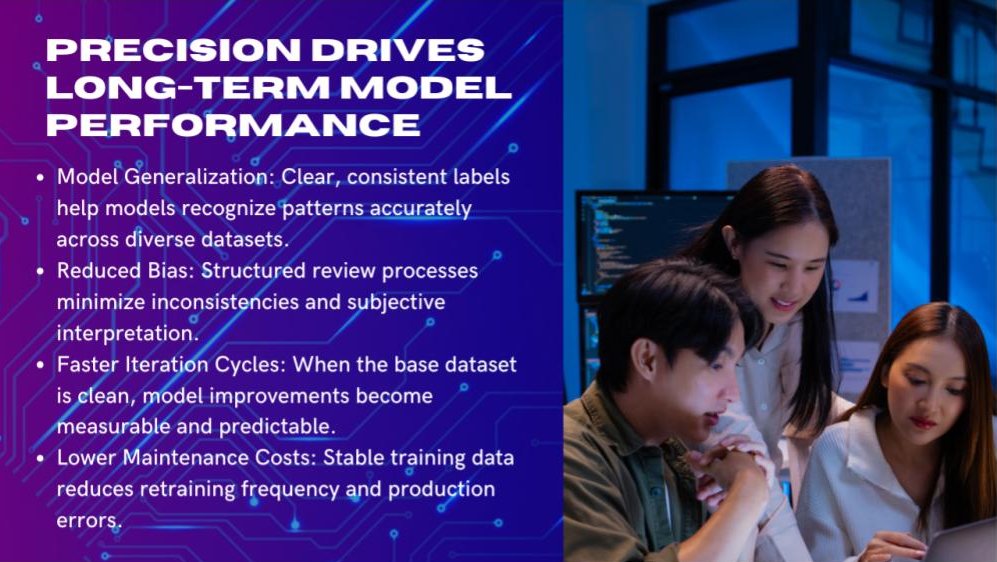
High-quality annotation supports:
- Stronger model performance over time
- More predictable optimization cycles
- Greater confidence from leadership teams
- Better preparedness for compliance requirements
- Improved user experiences at scale
At RF Tech, structured review and disciplined quality control are embedded into the annotation process from the start. The objective is not simply to deliver labeled data. The objective is to support models that remain accurate, stable, and scalable as they move into production.
In 2026, AI adoption continues to accelerate. Innovation moves quickly. Expectations are higher than ever. Within that environment, accuracy remains the steady factor that determines whether a system performs consistently or struggles to meet its benchmarks.
Final Thoughts: Quality in Data Annotation Shapes Everything That Follows
Data annotation is quiet work, but it shapes everything an AI system becomes.
Organizations that invest in doing this well from the beginning avoid costly rework later. They build systems that perform steadily in real-world conditions, not just in controlled testing environments.
In 2026, AI continues to move forward at a rapid pace. The pressure to deliver quickly will not disappear but the systems that last are built on clean, carefully reviewed data.
RF Tech supports teams with structured data annotation services designed for accuracy, clear review workflows, and long-term model performance.
Learn more about our Data Annotation Services here:
https://rftechitsolutions.com/services/