
Right now, AI teams everywhere are sweating over compliance. With the EU AI Act in full swing and a massive global spotlight on “ethical AI,” the pressure to build fair, unbiased models has never been higher.
But when models get it wrong, we tend to blame the algorithm. We obsess over the math, tweak the code, and adjust the weights. The reality, though? AI bias rarely starts in the code. It starts in the dataset.
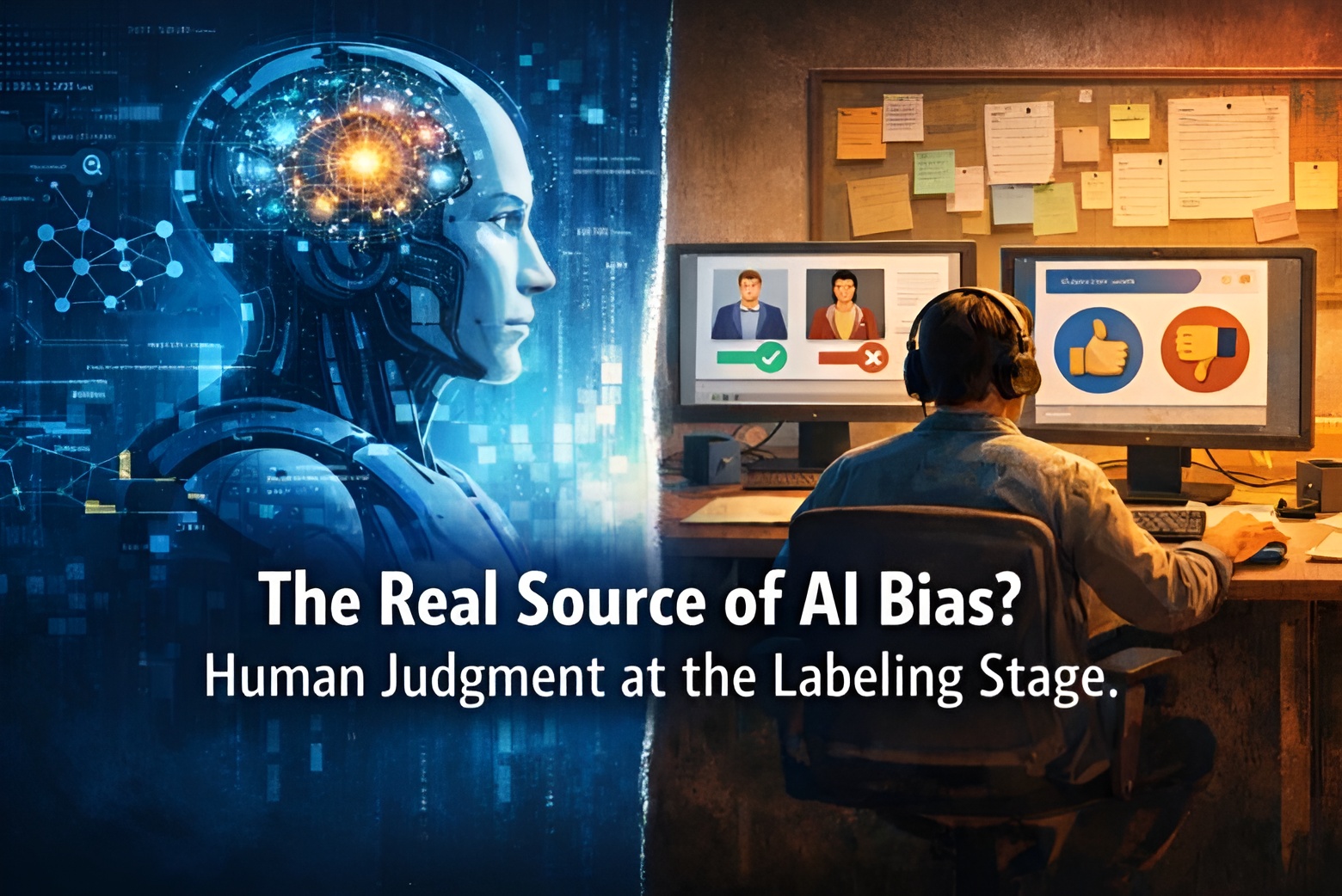
To understand why, you have to look at how models actually learn. If you are still wondering, think of it as a human playing the role of a teacher, showing a machine how to interpret the world. And humans (no matter how well-intentioned), are subjective. We all carry our own cultural contexts, assumptions, and blind spots.
When an annotator is sitting at their screen trying to figure out how to label a borderline image or a sarcastic piece of text, they have to make a judgment call. Without crystal-clear guidelines, their personal subjectivity gets baked right into your dataset. It’s a sobering thought: a single annotator’s quick decision on a Tuesday afternoon will directly shape how your enterprise model behaves when it goes live.
The fight for AI fairness isn’t happening in the code repository. It’s already here and happening on the labeling floor. Here is why data annotation is your true battleground for ethical AI, and how you can protect your models from systemic bias before the first line of code is even written.
The Hidden Danger of Subjective Edge Cases
Machine learning models are pattern-recognition systems. They do not apply intuition or common sense. They learn from the ground truth defined by labeled data.
When annotation guidelines lack precision, annotators rely on interpretation. Interpretation introduces variability. Variability, when scaled across thousands or millions of data points, becomes systemic bias embedded in the model.
Subjective edge cases create risk when they are not formally defined.
Common sources of bias include:
- Incomplete representation across demographic groups
- Lighting conditions that affect object visibility
- Mobility aids such as wheelchairs or assistive devices not clearly categorized
- Cultural or linguistic variations in NLP datasets
- Overlapping object classes without explicit decision rules
In computer vision systems used for autonomous driving or security monitoring, for example, unclear edge case handling can produce measurable performance gaps. If guidelines do not define how to label diverse skin tones under different lighting conditions, annotators may apply inconsistent standards. If assistive devices are not explicitly addressed, they may be mislabeled or ignored. These decisions do not remain isolated. They accumulate.
The model then learns to perform well on frequently represented “default” scenarios while underperforming in less represented conditions. Performance gaps emerge in precisely the situations where reliability matters most.
Bias in this context is not malicious intent but the direct result of undefined rules applied at scale. When edge cases lack clear definitions, drift becomes inevitable. Without structured escalation paths and documented resolution standards, small interpretive differences compound into systemic inconsistencies. Model stability depends on disciplined edge case handling because bias begins where ambiguity is allowed to scale.
Bias begins where ambiguity is allowed to scale.
Does Diversity Matter in Annotation Teams?
When annotation teams share similar cultural backgrounds, regional norms, or linguistic habits, their interpretations tend to converge in predictable ways. That convergence may feel consistent, but it can narrow the dataset’s range of representation. In tasks involving sentiment analysis, intent classification, content moderation, or visual categorization, subtle cultural context shapes labeling decisions. Without perspective diversity, models risk overfitting to a single demographic frame of reference.
Enterprise AI systems operate across geographies, languages, and user groups. Training data should reflect that breadth. Diverse annotation teams introduce variation in interpretation before the model reaches production. They surface assumptions earlier. They question edge scenarios that might otherwise pass unchecked. When supported by structured QA processes, diversity functions as a practical risk-control mechanism rather than a symbolic initiative.
A well-calibrated, diverse team improves signal quality by expanding contextual awareness at the point where labels are defined.
Quality Assurance (QA): The Frontline Against Bias
Mitigating bias is not only about who labels the data. It is about how labeling decisions are reviewed and validated. Relying on a single annotator’s judgment for complex or subjective tasks introduces compliance and performance risk.
Enterprise AI systems require structured Quality Assurance workflows designed to detect inconsistency before it reaches production. This includes multi-layer review layers, consensus validation processes, and Inter-Annotator Agreement metrics where multiple annotators independently evaluate the same asset to confirm consistency. Agreement tracking exposes ambiguity in guidelines and reveals areas where interpretation diverges.
This is why structured review systems surface subtle bias patterns that rushed, single-pass pipelines allow to pass through unchecked.
Implementing layered QA increases project time and operational cost. It also reduces regulatory exposure, retraining cycles, and reputational risk. For enterprise teams operating under compliance scrutiny, disciplined QA is not overhead. It is risk control embedded directly into the dataset.
Protect Your Model’s Integrity with RF-Tech
Your model is only as fair, safe, and reliable as the data it trains on. In an era of high regulatory scrutiny, enterprise teams cannot afford to treat data annotation as a cheap, afterthought commodity.
At RF-Tech, we understand that mitigating bias requires more than just raw workforce scale. It requires diverse teams, highly precise guidelines, and structured, accountable QA processes.
Still Juggling Disconnected Fundraising Tools? Let’s Fix That.
Schedule a working session with our team to review your current tech stack, identify integration gaps, and map a clean path into HubSpot. We’ll help you clarify your source of truth, streamline data flows, and build workflows that actually support your fundraising goals.