
Gen Z Prefers Freelancing. And We Can’t Blame Them.
For previous generations, starting a career followed a remarkably predictable path: finish school, land an entry-level job, put in the time, and climb the corporate ladder until reaching a senior position.
Gen Z, however, isn’t convinced that traditional trajectory still makes sense. Instead of relying on a single employer, younger professionals are quietly redefining what work looks like.
Some balance full-time roles with late-night freelance gigs, while others patch together a mix of part-time client work, online businesses, and personal projects. Some use freelancing as a stepping stone to permanent employment, while a growing number are asking an even bigger question: do they need a traditional job at all?
This shift toward a “portfolio career” is quickly gaining traction. If you’re not yet familiar with this term, it means building a working life around diverse roles, skills, and income streams. In an uncertain job market, diversifying income feels far more realistic than betting everything on climbing one company’s ladder.
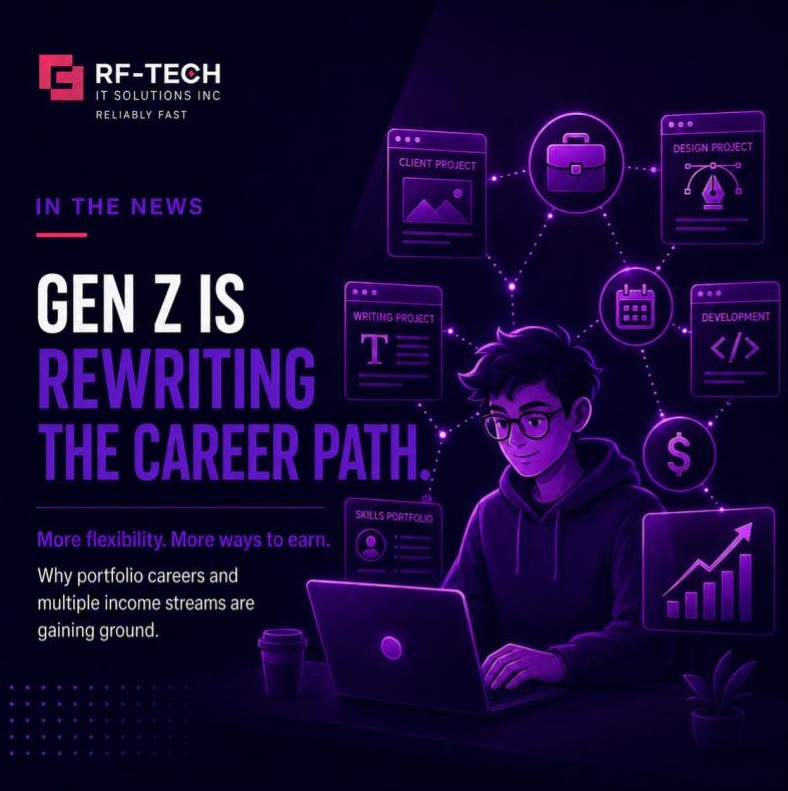
Freelancing No Longer Feels Like an Unusual Career Choice
While freelancing is nothing new, finding clients used to hinge entirely on who you knew and where you lived.
The internet completely erased those boundaries. Today, geographic distance is irrelevant. a Davao-based designer builds brand identities for Australian startups, a virtual assistant in Cebu manages operations for US executives, and a Manila writer scales multiple global accounts without ever setting foot in a physical office.
Thanks to modern job platforms, digital payments, and remote collaboration tools, striking out on your own has never been easier. But access is only half the story; visibility is what changed the game. Young professionals scroll past freelancers every day; creators, developers, consultants, and editors sharing the transparent realities of making a living outside the traditional office. When independent work is everywhere on your feed, it stops feeling like a risky backup plan and starts looking like a legitimate career path.
This mindset shift is especially pronounced among Gen Z. Upwork’s 2026 Future Workforce Index found that 53% of skilled Gen Z workers in the United States were already freelancing. While the figure represents one market, it reflects a broader shift in how younger professionals are approaching their careers.
One Job Can Feel Like a Risky Place to Keep All Your Income
Freelancing is often associated with financial uncertainty. But… traditional 9-5 jobs no longer feel completely secure either.
This generation’s fresh grads entered the workforce at a time of a global, economic crises, a war in Iran and cost-of-living crises. The Gen Z workforce has seen repeated layoffs, rising living costs, rapid technological change, and growing concern about which roles may be affected by artificial intelligence. Many have watched experienced workers lose jobs despite years of loyalty to an employer.
That experience has changed how some people think about security.
Depending entirely on one salary means that losing one job can remove a person’s entire income. Someone with a full-time position, two occasional clients, and a small online business still faces uncertainty, but their earnings come from several places. This does not guarantee financial stability but it can, however, provide another option when one source of income changes unexpectedly.
The appeal is particularly understandable in the Philippines. A Business Mirror survey cited during renewed calls for stronger freelancer protections found that 65% of Filipino Gen Z workers had side gigs or additional jobs. This was considerably higher than the reported global Gen Z average of 46%.
For some young Filipinos, an additional income stream helps cover rising household expenses. For others, it provides savings, supports family members, or creates a path toward greater financial independence.
A Portfolio Career Offers More Than One Way Forward
A portfolio career can look different for every person. A social media specialist may work full-time for an agency while managing one small business account on weekends. A teacher may offer online tutoring after school. A designer may divide the week among three regular clients. A video editor may accept short projects while building a content channel of their own.
The common feature is that the person’s career is spread across more than one professional activity.
Research shared in the original Times of India report found that 75% of Gen Z entrepreneurs in India manage multiple sources of income, compared with 62% of Gen X entrepreneurs. Although this data is specific to India, the motivations behind it will sound familiar to young workers elsewhere. Multiple income streams can provide greater control, allow people to explore different interests, and reduce their dependence on a single opportunity.
A portfolio career can also make professional growth feel less linear. Someone does not have to wait for a promotion before trying a new kind of work. They can test a skill through one small project and decide later whether they want to develop it further.
Young Professionals Want More Control Over Their Time
A traditional schedule determines when employees begin work, when they take breaks, and sometimes where they need to be. Freelancers may have more room to decide when and how they complete a project, depending on the agreement with the client. That flexibility can be valuable for young professionals who are:
- Continuing their education
- Caring for children or family members
- Managing health concerns
- Living far from major business districts
- Building a small business
- Working with clients in different time zones
- Pursuing creative or personal interests
Previous Upwork research found that 70% of Gen Z freelancers chose this type of work partly for greater schedule flexibility. Others valued location freedom, meaningful projects, and more control over their professional development. Of course, having control over your schedule does not always mean working fewer hours.
Freelancers still deal with deadlines, client calls, revisions, and periods when several projects become urgent at once. The difference is that many young professionals would rather manage those demands within a schedule they helped create.
Freelancing Lets People Build Experience Without Waiting for Permission
Instead of listing static, single-sentence examples and a long, bulleted grocery list of industries, weave the examples into real-world scenarios and integrate the fields directly into the flow of the narrative.
One of the most frustrating paradoxes of starting out is the classic dilemma: you need experience to get an entry-level job, but you need a job to get experience. Freelancing offers a clever back door.
Instead of waiting for a hiring manager to take a chance on them, young professionals can start building a track record on their own terms. That might look like a beginner writer crafting blog posts for a neighborhood coffee shop, an aspiring marketer running campaigns for a local non-profit, or a self-taught developer building a simple site for a family friend. These early projects may start small, but they yield something far more valuable than a resume line: concrete proof of capability.
Over time, those individual gigs stack up into a tangible portfolio. This work-first proof is especially powerful in creative and tech-driven fields, from graphic design, video editing, and digital marketing to web development, data annotation, and virtual assistance, where clients and employers care far more about what you can build than where you went to school.
Beyond proving your skills, taking on varied projects acts as a fast-track business education. Managing clients across different sectors; say, a local restaurant, an e-commerce brand, and a tech startup, exposes you to different business models, communication styles, and operational challenges much faster than sitting in a single junior role ever could. And if you do eventually decide to apply for a traditional full-time job, you step into the interview not as a candidate hoping for a chance, but as a proven contributor with real-world results.
Social Media Has Changed What a Career Can Look Like
Gen Z grew up watching people turn skills and interests into visible sources of income.
A person can post artwork and receive design enquiries. Someone who shares useful career advice can begin offering consultations. A hobby photographer can book weekend shoots. A skilled gamer can edit videos or manage an online community.
Social media allows young professionals to show their work before a company officially gives them a job title.
It has also made career paths more visible. People share how they found clients, prepared portfolios, negotiated rates, left full-time jobs, and recovered from unsuccessful projects. Young workers can see many ways of building a career beyond the examples available in their immediate families or communities.
However, social media also presents an incomplete picture.
Freelancing videos may show someone working beside the beach or earning a large amount from one project. They rarely show the unpaid proposals, difficult clients, tax responsibilities, late invoices, inconsistent workloads, and hours spent looking for the next opportunity.
That does not make freelancing a poor choice. It means the choice deserves a realistic understanding.
Visibility, AI, and the Reality of Modern Work
Social media effectively eliminated traditional gatekeepers: post your artwork online and design inquiries follow; share sharp career insights and consulting gigs pop up; edit gaming clips and you’re managing online communities. Rather than waiting for a company to bestow an official job title, young professionals can publish their work and build an audience directly.
Equally important is the transparency this creates. Online creators regularly pull back the curtain to share how they landed clients, built portfolios, set rates, and navigated setback, offering a blueprint far richer than the traditional career advice previous generations relied on.
Yet social media often presents a curated highlight reel. Aesthetic videos of working by the beach rarely capture the tedious reality: chasing unpaid invoices, wrestling with taxes, pitching cold prospects, or managing the anxiety of fluctuating monthly income. Independent work isn’t inherently bad, but it demands an honest look at the trade-offs.
Compounding this dynamic is the rise of artificial intelligence, which brings both disruption and leverage. On one hand, automated tools are swallowing up the repetitive tasks historically given to junior employees, making conventional entry-level paths feel increasingly fragile. On the other hand, AI equips solo freelancers to punch above their weight class, streamlining research, drafting outlines, automating admin, and handling tasks that once required an entire team.
The real differentiator, however, remains human judgment. Upwork’s 2026 Future Workforce Index highlights this split: freelancers executing complex, AI-augmented work saw earnings jump 45% year-over-year, while contract rates for basic, low-complexity AI output fell by 13%. Simply knowing how to prompt a tool isn’t enough. The real value lies in pairing digital tools with deep domain knowledge, sharp critical thinking, creative vision, and the discernment to know when the output falls short.
The Reality Check: Counting the Costs Before Going All-In
Freelancers often need to find their own clients, discuss rates, clarify project requirements, manage revisions, issue invoices, follow up on payments, and keep track of income and expenses. They may also need to arrange their own health coverage, government contributions, equipment, internet connection, and emergency savings.
There may be no paid leave when they become sick. A holiday can mean losing billable hours. A client relationship can end with little warning. Working with several clients can also become difficult when every deadline arrives at once. The flexibility that attracted someone to freelancing can disappear if they accept more work than they can realistically manage.
Before taking on freelance work, young professionals should consider:
- What service they can confidently offer
- How much time they can commit
- How they will calculate and communicate their rates
- What will be included in each project
- How many revisions they will accept
- When and how clients should pay
- Whether they need a written contract
- How they will protect confidential client information
- How much they should save for slow periods
These details may feel less exciting than creating a portfolio or announcing a new service, but they are what make independent work more sustainable.
Young Professionals Are Building Careers Differently
Gen Z is entering a working world where stability, ambition, and success look different from how they did a generation ago.
Many young professionals still want traditional jobs. They value mentorship, steady income, professional communities, and opportunities to grow within an organisation. At the same time, more of them are unwilling to let one employer define their entire career or control every source of income.
Freelancing gives them another way to gain experience, explore their interests, build financial options, and create more control over their working lives.
The result may be a generation with careers that are harder to explain in one job title. Someone can be an employee, consultant, creator, and small-business owner during the same year, or even during the same week.
That path comes with uncertainty, but uncertainty already exists in traditional employment. For many young professionals, building several possibilities feels like a practical response to the working world they have inherited.
Have you ever considered freelancing or adding another income stream alongside your current work? Share your thoughts with RF-Tech on Facebook or get in touch with the team. We’d love to hear what today’s ideal career looks like to you.