
By now, we’ve moved past the “can this work?” phase of AI. In 2026, the question is “can this work reliably for a million users?”
That shift in perspective has changed the math on data annotation. When budgeting for a pipeline, think of labels as the ‘digital food’ that dictates your model’s ultimate safety and performance.
Pricing isn’t random. It’s a formula based on four pillars: data complexity, specialized expertise (like medical or legal), the QA workflow, and your delivery timeline. Understanding these variables is the only way to compare vendors without comparing apples to oranges.
Before comparing vendor rates, make sure everyone involved understands what data annotation is and how it works in practice.
So, ready to talk numbers? Let’s break down the factors that actually drive the cost.
Data Type Changes the Cost Structure
Pricing starts with the complexity of the data itself. A general rule: the more specialized the data, the higher the human oversight required.
- Computer Vision: Basic bounding boxes are relatively straightforward. However, costs rise with pixel-level segmentation, where annotators must outline exact contours. This level of precision requires significantly more time and a multi-stage review process.
- LiDAR and 3D Point Clouds: These tasks require spatial reasoning. Annotators must interpret depth and object overlap across three-dimensional space, requiring a more technical skill set and specialized software.
- Medical & Scientific Data: This often requires Subject Matter Experts (SMEs). When an annotator needs a medical background to identify a scan, or when error tolerances are near zero due to regulations, the price reflects that expertise.
- Natural Language Processing (NLP): Sentiment analysis is high-volume and fast. In contrast, training an LLM on multi-turn reasoning or nested entity recognition requires nuanced interpretation and longer review cycles.
As tasks shift from “simple identification” to “expert interpretation,” the labor hours and QA requirements scale accordingly.

Task Complexity: Why “Simple” Images Can Still Be Expensive
While data type defines what you are labeling, task complexity dictates how long it takes to get it right. Your budget is ultimately a reflection of the ‘mental load’ required for every decision an annotator makes.
- Decision Depth: A simple binary classification (Yes/No) moves quickly. However, multi-class labeling, where an annotator chooses from dozens of granular tags, increases the cognitive load per decision and slows down the pace.
- Precision Requirements: Tasks like keypoint detection demand extreme positional accuracy. Placing a single point on a joint or a corner takes seconds; placing dozens of them with sub-pixel precision across a dataset takes hours of focused labor.
- Temporal Continuity: Video tracking is a force multiplier for cost. Annotators aren’t just labeling one frame; they are ensuring an object’s ID remains consistent across thousands of sequential frames, which requires significant review oversight.
- The “Edge Case” Factor: Ambiguity is the enemy of a fixed budget. When edge cases require escalation to a manager or a rule clarification, production slows down. These “gray areas” often require the most expensive type of labor: expert deliberation.
The bottom line: Every layer of complexity adds minutes to the asset. Because cost follows time and time follows difficulty, a “complex” task will always carry a premium over a “high-volume” one.
Quality Assurance Is One of the Biggest Pricing Drivers
A vendor’s QA structure is often the clearest indicator of their pricing tier. While a single-pass workflow keeps immediate expenses low, it introduces significant model risk by leaving no room for error detection.
High-quality annotation relies on structured safeguards. This includes inter-annotator agreement tracking, random audits, and documented dispute resolution processes. These systems require dedicated management and coordination, which increases the upfront cost but ensures a much cleaner dataset.
The stakes are especially high for AI systems handling credit approvals, medical reviews, or fraud detection. In these regulated environments, annotation errors are operational liabilities. When a model treats a flawed label as absolute truth, it embeds those weaknesses into its core logic. Over time, these small inconsistencies compound into massive technical debt. Engineering teams end up wasting weeks debugging unpredictable outputs, retraining cycles multiply, and infrastructure costs balloon
This is why prioritizing accuracy over speed is critical. It prevents the ‘hidden’ costs of re-labeling and ensures your model performs reliably in production.
The “Urgency Premium”: Why Speed Increases Cost
Delivery speed is a variable that many teams underestimate during the budgeting process.
Standard timelines allow for controlled staffing and steady calibration cycles. However, as soon as a project becomes a “rush,” the operational requirements change. Accelerating a delivery date requires expanded teams and compressed review loops, which in turn demands much tighter project management to keep everyone aligned.
This extra layer of coordination is essential to protect the quality of the data under time pressure. Essentially, a faster turnaround carries a higher price tag because it demands a more intensive level of oversight to ensure that speed never compromises the integrity of your model.
Why the Cheapest Option Rarely Stays Cheap
Low-cost vendors typically hit aggressive rates by stripping away the structures that guarantee quality. To save on labor, they often shorten onboarding, simplify guidelines, and remove the multi-layer reviews that catch subtle errors.
So, while the initial quote may look attractive, the reliability of the dataset suffers. In production, this lack of rigor translates to declining precision, rising false positives, and a model that fails to handle real-world edge cases.
The burden then shifts to your engineering team. They end up redirecting weeks of high-value time toward fixing preventable data issues and managing emergency retraining cycles. Because the cost of re-labeling a failed dataset almost always exceeds the savings of a low initial bid, the total cost of ownership is a far more accurate metric than the per-item price.
Beyond the Rate Sheet: How to Evaluate a Data Annotation Partner
Strong AI teams treat budgeting as risk management. The lowest quote rarely tells you how the dataset will perform under real-world pressure.
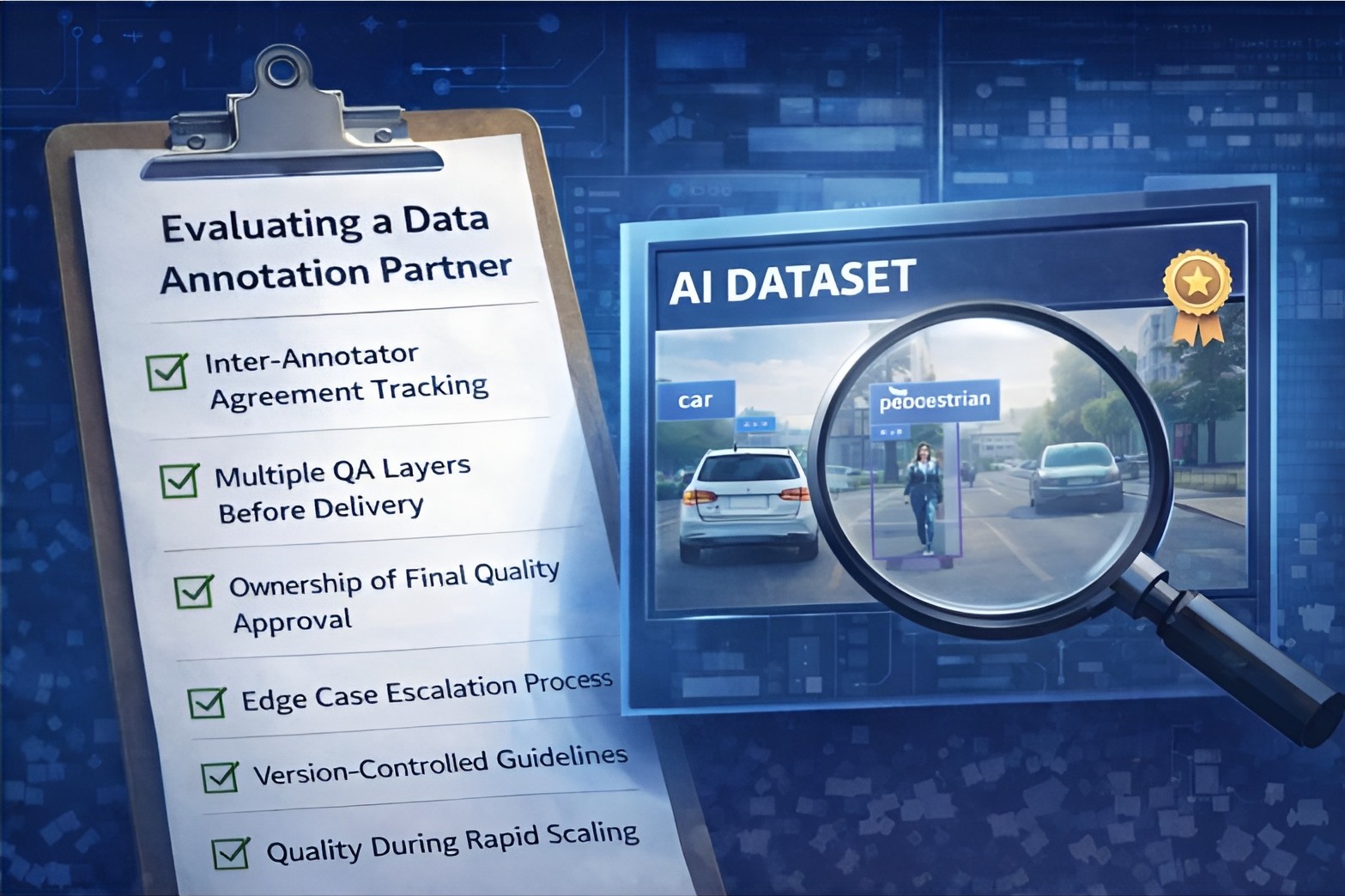
When evaluating a data annotation partner, look beyond per-item pricing and examine operational structure. Ask direct questions about:
- How inter-annotator agreement is measured and tracked
- How many QA layers exist before delivery
- Who owns final approval and sign-off
- How edge cases are escalated and documented
- Whether annotation guidelines are version-controlled and updated systematically
- How quality is maintained during rapid scaling
Consistency at small volume means little if accuracy drops during scale. A serious partner should explain how teams are calibrated, how discrepancies are resolved, and how performance benchmarks are enforced over time. Starting with a structured pilot reduces risk before full deployment.
A pilot allows you to:
- Measure agreement scores in a controlled environment
- Evaluate edge case handling
- Review documentation clarity
- Assess communication responsiveness
Production scale should follow measurable performance, not assumptions.
Final Thoughts: Pricing Reflects Design
Ultimately, the cost of data annotation is a reflection of four key decisions: data specialization, task complexity, QA depth, and delivery timeline. Each of these variables represents a choice about the accuracy, risk level, and long-term stability of your model.
Data annotation is a critical performance input that shapes how your model behaves in the real world. By investing in a structured, quality-driven workflow today, you prevent the expensive “hidden costs” of model failure tomorrow.
Ready to build a high-performing data pipeline?
Let’s Talk About Developing Your Custom Annotation Roadmap
Connect with our team to audit your project’s complexity and build a scalable labeling strategy that aligns your budget with your model’s specific accuracy targets.