
It’s easy to label a few hundred images on your own. It’s an entirely different beast to manage the labeling of 100,000 assets for a production-grade model. At that scale, every small internal ambiguity becomes a massive, expensive bottleneck, like a vague label definition or a messy file format.
The success of your annotation partnership is usually decided long before your first vendor call. It comes down to internal readiness. To move confidently into production, your team must be aligned on five pillars: clean datasets, precise guidelines, volume expectations, quality metrics, and a realistic calendar. Taking the time to nail these details today is what prevents friction, stops re-labeling cycles, and keeps your roadmap on track.
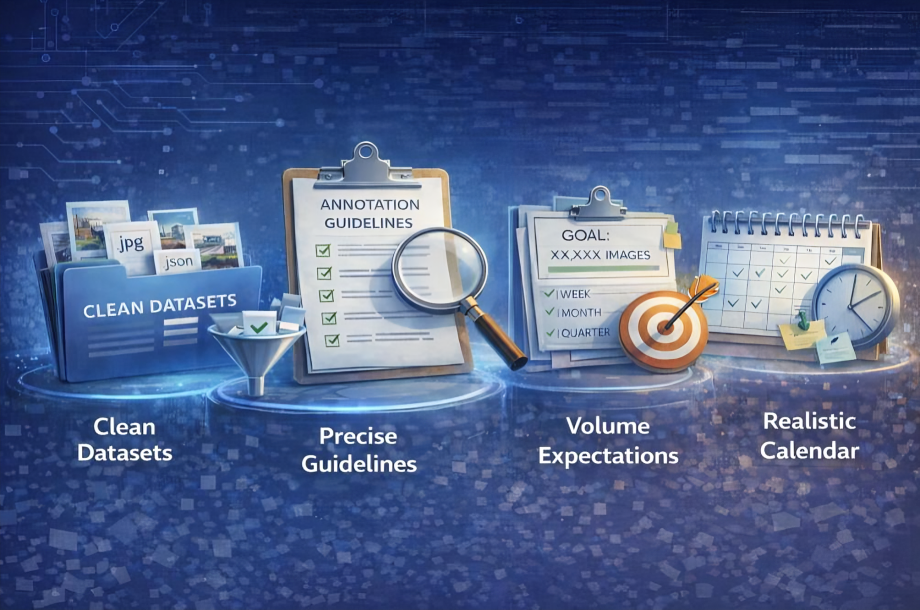
Dataset Readiness: Preparing the Foundation
Many annotation partnerships stall before the first label is even created because the raw data isn’t ready for a structured workflow. When files are inconsistently formatted or metadata is missing, it creates immediate friction. Your annotation partner is effectively a high-speed engine; if the “fuel” (your data) is contaminated with duplicates or broken file paths, that engine will seize.
It is important to remember that annotation is a structuring process, not a data cleaning service. If a source dataset is disorganized, those weaknesses will propagate into the labeling decisions and eventually into the model’s behavior. This is a primary driver of model instability: unclear datasets create compounding errors that often don’t surface until the model is already in production.
Before engaging a vendor, run a quick internal audit to confirm:
- Standardized Formats: All assets (images, text, or sensor logs) should follow a uniform file type and resolution.
- Consistent Naming: File naming conventions should be predictable to prevent “lost” assets or broken links in the labeling tool.
- Defined Metadata: Any required context (date, location, sensor ID) must be attached to the asset before it reaches the annotator.
- Duplicate Removal: Cleaning your data beforehand ensures you aren’t paying to label the same information twice.
- Edge Case Identification: Spotting obvious “gray areas” early allows you to build rules for them before they slow down production.
Investing a few days into dataset hygiene saves weeks of expensive manual correction later.
Annotation Guidelines: The Blueprint for Consistency
Once your data is clean and standardized, the focus shifts from the assets to the instructions. Even the most organized dataset will fail to produce results if the annotation rules lack precision.
Vague instructions force annotators to make subjective guesses. These guesses lead to inconsistent labels, which ultimately degrade model accuracy and force expensive retraining cycles. To keep production moving, your annotation guidelines must be exhaustive and leave little room for interpretation.
A production-ready guideline should define:
- Granular Category Definitions: Clearly state what each label represents with no overlap between categories.
- Positive and Negative Examples: Show annotators exactly what to include and, just as importantly, what to ignore.
- Edge Case Protocols: Provide a “decision tree” for the common gray areas your team identified during the data-cleaning phase.
- Escalation Paths: Establish a clear chain of command for when an annotator encounters an asset that doesn’t fit the current rules.
- Version Control: Ensure there is a system to document and distribute rule changes so the entire team stays in sync.
One of the most common bottlenecks occurs when internal stakeholders disagree on a label’s definition. If your own engineering and product teams aren’t aligned, those contradictions will inevitably surface during production, causing stalls and re-work. Resolving these debates before the project begins is the best way to reduce review friction and make your Quality Assurance (QA) measurable.
Operational Clarity: Volume, Quality, and the Calendar
If the guidelines are the blueprint, your operational targets are the engine. Clear expectations around volume and quality determine how a partner staffs your project and how they manage their internal workflows. Without these numbers, a partnership can quickly lose its direction.
Volume Forecasting: Setting the Pace
Predictability is the most valuable asset you can provide a labeling partner. Sudden spikes in volume can strain a team, while unexpected lulls leave expensive resources idle. Before the project begins, establish a baseline for:
- Total Dataset Size: How many assets do you need labeled in total?
- Weekly Throughput: What is the steady-state volume your model pipeline requires?
- Scaling Milestones: If you plan to ramp up from 10,000 to 100,000 items, what is the specific timeline for that growth?
Defining the “North Star” for Quality
Vague requests for “high quality” lead to vague results. To keep a vendor accountable, you must define the specific metrics that indicate success for your model. This usually involves:
- Inter-Annotator Agreement (IAA): How often do two or more people need to agree on a label for it to be considered “truth”?
- Gold Standard Sets: A pre-labeled “perfect” dataset used to test annotator accuracy throughout the project.
- Precision vs. Recall: Does your model prioritize finding every possible object (recall), or ensuring that every object found is correctly identified (precision)?
Timeline Realism: Calibration Takes Time
Every new annotation project requires a “calibration period”, or a phase where the team learns your specific edge cases and refines their speed. Rushing this phase is the fastest way to embed errors into your dataset. A realistic timeline accounts for:
- Onboarding and Training: The time required for annotators to master your guidelines.
- Feedback Loops: The scheduled intervals where your team reviews batches and provides course corrections.
The “Pilot” Phase: A smaller initial run to prove the workflow before opening the floodgates to full production.
Quality Metrics: Define Accuracy Before Production Starts
Quality expectations should never be a guess; they have to be a contract. If you wait until after the data is labeled to decide what “good enough” looks like, you are already behind. Disagreements over accuracy are the most common cause of project stalls, budget overruns, and friction between teams.
To keep a partnership on track, you must move beyond vague requests for “high quality” and define your specific “North Star” metrics. Before production begins, ensure your team is aligned on:
- Target Accuracy Benchmarks: What is the hard percentage of correct labels required for your model to perform?
- Defined Review Layers: How many sets of eyes need to see an asset before it is considered “truth”?
- Audit Sampling Percentages: What portion of the work will be randomly checked for consistency throughout the project?
- Documentation Standards: How will errors and edge-case decisions be logged so your team can review them later?
Multiple review layers are essential when a model influences real-world decisions. Prioritizing accuracy over speed is what prevents the “hidden” costs of re-labeling and ensures your model remains stable in production.
Once these quality gates are firmly in place, you can finally turn your attention to the calendar. Defining your “what” and your “how good” allows you to build a schedule that is actually achievable.
Timeline Alignment: Why Speed Requires Structure
Your delivery expectations dictate the entire operational design of a project. If your roadmap includes strict deployment deadlines, the annotation workflow must account for expanded teams and much tighter management oversight to keep quality from slipping. Conversely, if your timeline is flexible, production can proceed with steadier review loops and more controlled scaling.
To avoid mid-project tension, your team must define its “calendar” early. This includes establishing launch deadlines, milestone checkpoints, a consistent feedback cadence, and critically buffer time for guideline revisions. Structure is the only thing that keeps speed from turning into a risk; a well-defined timeline is what protects the integrity of your dataset.
Final Thoughts: Preparation Is Your Greatest Leverage
Hiring a data annotation partner is an operational commitment that directly influences your model’s stability and long-term ROI. The most successful AI teams enter these partnerships with leverage because they’ve done the internal work first.
By preparing your datasets, clarifying your guidelines, and setting measurable quality standards, you remove the guesswork that causes most projects to stall. Clear inputs and structured expectations create the only conditions under which a partnership can actually scale.
Talk to RF-Tech about your next dataset
Schedule a working session to audit your internal readiness and build a labeling strategy that aligns your quality thresholds with your production timeline.