
If you’re a fan of Stranger Things, you’ve probably heard that rumor circulating around the end of 2025 when the final season aired on Netflix that the whole season was written by ChatGPT. Why? Because some eagle-eyed fan (or critic?) spied a ChatGPT tab open in the Duffer brothers’ laptop. The rumor quickly grew wings and flew around the interwebs. And, depending if you loved or hated the final season, well – you might have just believed it.
And why not?
A few years ago, creating a believable cinematic world required massive teams of writers, artists, editors, animators, and VFX specialists working together for months.
Today, one person with generative AI can create realistic visuals, voices, scripts, and entire scenes from a laptop in a matter of hours.
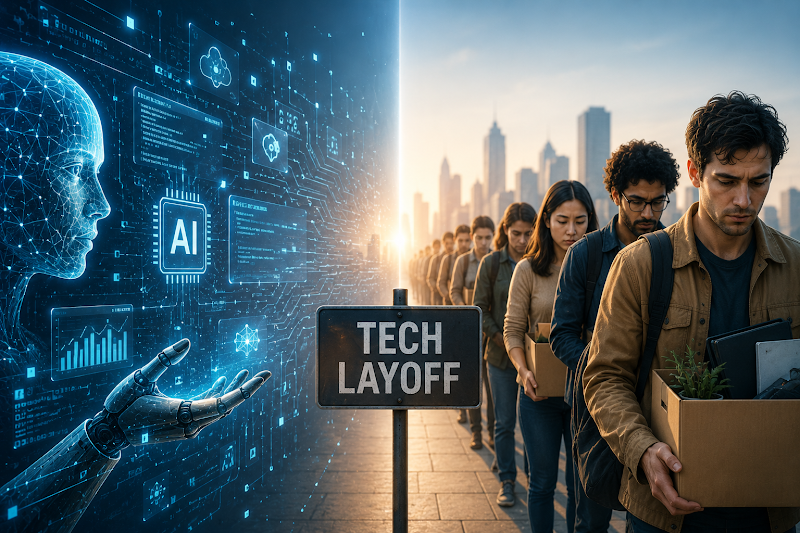
That shift is where the anxiety around AI truly begins.
For most of human history, our tools replaced physical labor. Machines lifted heavier objects, automated repetitive movement, and reduced manual effort. But AI feels different because it is beginning to imitate something we once believed belonged exclusively to people: creativity, reasoning, and communication.
Every day, millions of developers, writers, designers, marketers, and researchers contribute to systems increasingly capable of performing parts of their own jobs. By 2026, AI agents are already writing code, managing customer pipelines, generating content, and compressing work that once required entire teams into workflows handled by a handful of people.
So the question becomes unavoidable:
Why are we still building this?
1. The Ultimate Corporate Arms Race
The biggest reason the building won’t stop comes down to a giant, global game of chicken.
There is no single person, company, or government controlling AI development. Instead, it’s a nonstop competition between tech giants, startups, investors, and world governments all trying to move faster than everyone else.
For companies, the pressure is financial. AI promises faster workflows, lower labor costs, better products, and massive market advantage. If Company A pauses development because of ethical concerns or fears about job loss, Company B keeps going, releases a stronger product, and captures the market instead. Public companies also face pressure from investors who expect constant growth and innovation.
The same dynamic exists between countries. Governments increasingly see AI as a matter of economic power, military strength, cybersecurity, and political influence. Falling behind in AI is viewed the same way countries once viewed falling behind in manufacturing, nuclear technology, or the internet. That creates a situation where slowing down feels risky, even for people who openly acknowledge the dangers.
Many leaders in tech have warned about AI’s long-term consequences while continuing to invest billions into building it anyway. No one wants to be the side that stopped first while everyone else kept accelerating.
2. Humans Are Wired for Shortcuts
At our core, humans are constantly looking for easier, faster, and more efficient ways to survive and work. That instinct has shaped almost every major invention in history.
We invented the wheel because dragging heavy objects manually was exhausting. We built factories because producing everything by hand was slow and expensive. Computers replaced massive amounts of paperwork because humans hate repetitive tasks that consume time and energy.
AI is the next step in that pattern. The difference is that instead of reducing physical labor, it reduces mental labor. It can summarize information, generate content, analyze data, answer questions, automate customer service, and handle repetitive knowledge work that used to require hours of human attention.
For businesses, the appeal is obvious. If a task that once took ten employees eight hours can now be completed faster and cheaper with AI assistance, companies are going to use it. Even outside business, regular people are already relying on AI to save time on writing, studying, organizing, researching, and daily problem-solving.
Historically, almost every major technological shift has felt threatening to the people living through it.
Factory machines threatened artisans. Cars threatened horse-related industries. Computers threatened clerical work. The fear surrounding AI follows the same pattern, although it feels more personal because this time the technology is automating parts of thinking itself rather than just physical labor.
That’s why AI adoption keeps accelerating even when people are uneasy about it. Human beings have always chased convenience, speed, and efficiency, and AI offers all three at a scale that’s difficult to ignore.
3. The Real Human Cost
This is the part many conversations about AI skip too quickly because the disruption is no longer theoretical.
Programmers are watching teams shrink as companies rely more heavily on AI-assisted workflows. Designers and writers are facing pressure to produce faster and cheaper because “AI can help.” Entire departments are being consolidated around automation tools. And unlike previous industrial revolutions, this shift is happening across multiple industries at once.
Historically, labor transitions unfolded over decades. AI is compressing disruption into years. Current research from organizations like Goldman Sachs, the IMF, and McKinsey suggests AI could significantly reshape global labor markets, especially across knowledge work and creative industries.
That matters because work is not purely economic. Work provides structure, identity, stability, and purpose so when professions suddenly feel uncertain, people are not just reacting to lost income. They are reacting to the fear of becoming economically irrelevant.
Creative industries feel this especially deeply.
Artists spend years developing styles shaped by lived experience, emotion, and personal identity. Watching algorithms generate similar work in seconds raises ethical questions society still has not answered. Who owns artistic style? What counts as originality? What happens when human creativity becomes training data? The discomfort around AI art is not simply about competition but it refocuses on authorship itself.
And yet the tools remain undeniably powerful. That is the paradox: AI can simultaneously expand human capability and destabilize human security. Both realities are true.
4. The Human Premium
The assumption that automation automatically equals replacement is often too simplistic. In many industries, AI is changing where human value exists rather than eliminating it entirely.
Scientists can process larger datasets. Developers can prototype faster. Writers can compress research time. Businesses can automate repetitive operational tasks. As AI handles more baseline execution, human value increasingly shifts toward judgment, strategy, taste, emotional intelligence, and direction. The difficult part is that transitions are painful while they are happening.
Entire professions may shrink before new roles fully emerge. Some workers will adapt quickly. Others will struggle. History suggests humanity eventually reorganizes around new technology, but that does not make the transition emotionally easy for the people living through it.
5. The Question Is No Longer “Why”
At this point, humanity is unlikely to stop building AI. The incentives are too powerful. The efficiency gains are too large. The competitive pressure is too intense.
The more important question now is how society adapts responsibly. How do we preserve dignity during labor transitions? How do we protect creative ownership? How do we ensure people still have economic value in increasingly automated systems?
Those questions matter because the fear surrounding AI is deeply human because for the first time, many people are watching technology move into areas they believed made humans uniquely valuable. Maybe that discomfort forces us to confront a bigger question: If machines increasingly handle execution and optimization, what remains distinctly human? The answer may shape the next century more than AI itself.
Final Thoughts: What Happens When AI Learns Faster Than Society Adapts?
As AI continues reshaping industries, one thing remains clear: technology still depends on people. Behind every workflow, dataset, system, and automated process are human decisions, human oversight, and human adaptability.
The future of work will likely belong not to people who compete against AI, but to those who learn how to work alongside it thoughtfully and responsibly.
At RF-Tech, these conversations are more than industry headlines. They reflect the real changes happening across digital work, remote operations, data systems, and modern online careers every day.
What’s your take on it? Feel free to message us on Facebook or send us an email. We’re always open to hearing different perspectives.